10 Best Contract Management Software for Private Healthcare Providers in 2026
Ten contract management platforms for private hospitals, clinics and care groups, compared on BAA position, UK GDPR terms, best fit and pricing model.
 FIG · 01
The best contract management software for private healthcare providers in 2026 depends on where your contracts start. FlowForma Contract fits private hospital, care, and multi-site groups in the U.S., UK, and Ireland whose supplier and service contracts start as purchase requests or tenders. symplr Contract and Ntracts fit U.S. physician, payer, and BAA-heavy portfolios; Icertis, Ironclad, and Agiloft fit large networks; ContractSafe and ContractWorks fit independent practices.
Ask a U.S. or UK-based private hospital group where its imaging equipment lease lives, and you’ll often get three answers: a shared drive, a supply chain spreadsheet, and an email thread with the vendor’s latest redline. Physician agreements sit with the medical staff office, BAAs with compliance, and the notice date on the lab services contract sits in someone’s calendar, if it sits anywhere.
Some of these agreements carry patient data, which U.S. law treats as protected health information and UK GDPR as special category data; others start as a purchase request or a tender.
On the HIPAA side, that mix includes the business associate agreements themselves; if you need a starting draft for one, HipaaKit’s BAA Template Generator builds it.
| # | Software | HIPAA and BAA position (as each vendor states it, November 2026) | UK GDPR terms and data location (November 2026) | Best for | Pricing model (as of November 2026) |
|---|---|---|---|---|---|
| 1 | FlowForma Contract | Contact vendor for HIPAA and BAA position; ISO/IEC 27001:2022 certified | DPA with UK Addendum; EEA storage, Ireland primary; AI requests may leave the EEA | Supplier, equipment, service, and staffing contracts that start as purchase requests or tenders | Pricing on request |
| 2 | symplr Contract | HITRUST r2 certified; ask vendor about BAA (its BAA template is for your vendor agreements) | Ask vendor for UK GDPR terms | Hospital groups managing physician, supply chain, and vendor agreements | Pricing on request |
| 3 | Ntracts | HIPAA checks built into BAA intake; ask vendor about BAA | Ask vendor for UK GDPR terms | Physician groups and health systems that want contracts, compliance, and policy in one system | Custom enterprise subscription, all users included |
| 4 | Agiloft | SOC 1, SOC 2, ISO 27001, ISO 27701; ask vendor about BAA | DPA includes UK Addendum | Groups that need different approval paths per contract type and facility, configured without code | Quote-based |
| 5 | Icertis | Says it automates compliance with CMS and HIPAA requirements; ask vendor about BAA | Ask vendor for UK GDPR terms | Large networks with heavy payer and physician contracting | Pricing on request |
| 6 | Ironclad | Says it complies with U.S. HIPAA; ask vendor about BAA | Data center regions for residency (not named); DPA covers UK transfers | Legal-led groups with high contract volume | Custom quote shaped by products, users, and workflows |
| 7 | Docusign CLM | Business associate for eSignature with PHI; confirm BAA scope for CLM | DPA covers UK GDPR transfers | Organizations already standardized on Docusign eSignature | Pricing through sales |
| 8 | Conga CLM | Annual audits against the HIPAA Security Rule; DPA commits to a BAA when Conga processes PHI | DPA covers UK GDPR; ask about hosting region | Groups running commercial operations in Salesforce | Pricing on request |
| 9 | ContractSafe | Says it is HIPAA compliant; SOC 2 Type II, ISO 27001 | DPA on request, with UK Addendum; Ireland hosting option | Independent practices that need a searchable repository with renewal alerts | Published, based on contract volume and features |
| 10 | ContractWorks | SOC 2 Type 2; HIPAA listed on Onit’s trust center; ask vendor about BAA | U.S. and EU data centers; Onit’s DPA includes the UK Addendum | Small clinics that want a repository with fast setup | Repository and Premium starting prices published; Premium through sales |
The HIPAA and UK GDPR columns record each vendor’s position in its own words, as published in November 2026. Where a row says to contact or ask the vendor, its public pages didn’t settle the question, so it belongs on your first call. Even a stated position only opens the conversation: whether you need a BAA or Article 28 terms at all depends on whether the platform will store or process patient data for you.
What features should contract management software have for private hospitals and clinics?
Contract management software for a private healthcare provider keeps every agreement in one searchable register, routes each contract to the right clinical, legal, finance, and compliance approvers, and alerts owners before notice dates. It logs every approval, so clinical, payer, supplier, and BAA records are ready when an auditor or a payer asks for them.
The six stages of the healthcare contract lifecycle
A medical director agreement and a linen service renewal pass through the same six stages:
- 1Request
- 2Drafting
- 3Approval
- 4Negotiation and signature
- 5Obligation monitoring
- 6Renewal or termination
Contract management software automates approvals by routing each contract on rules for type, value, and facility. A supplier contract above a set threshold goes to finance, and a physician agreement goes to compliance before signature.
The bigger difference is where the request comes from. The directorship agreement starts in the medical staff office and carries compensation terms that compliance has to review. A supplier contract usually starts as a purchase request or a tender, and that decision matters again at renewal, when someone asks why this vendor won.
A few platforms are built around this second path: symplr Contract includes supply chain request workflows, and FlowForma Contract runs purchases, tenders, and contracts in one system.
How each platform was judged
Each platform was assessed from vendor documentation and public material as of November 2026, not hands-on testing, and checked against six capabilities:
- A searchable central register
- Approval routing that follows contract type and value
- Templates and a clause library
- Built-in or connected e-signature
- Alerts tied to notice periods rather than expiry dates
- An audit trail of who approved what, and when
Platforms are ordered by fit for the contract types private providers manage, not by an overall score.
What are the 10 best contract management software tools for private healthcare providers in 2026?
The 10 platforms below are ordered by fit for the contract types private providers manage, starting with supplier contracts that begin as purchases or tenders. symplr Contract and Ntracts are built only for healthcare agreements. FlowForma Contract and Agiloft center on configurable approval and purchasing workflows. Icertis, Ironclad, Docusign CLM, Conga CLM, ContractSafe, and ContractWorks are general-purpose, from enterprise suites to simple repositories for independent practices.
1. FlowForma Contract: Best for Supplier, Equipment, and Service Contracts That Start as Purchases or Tenders
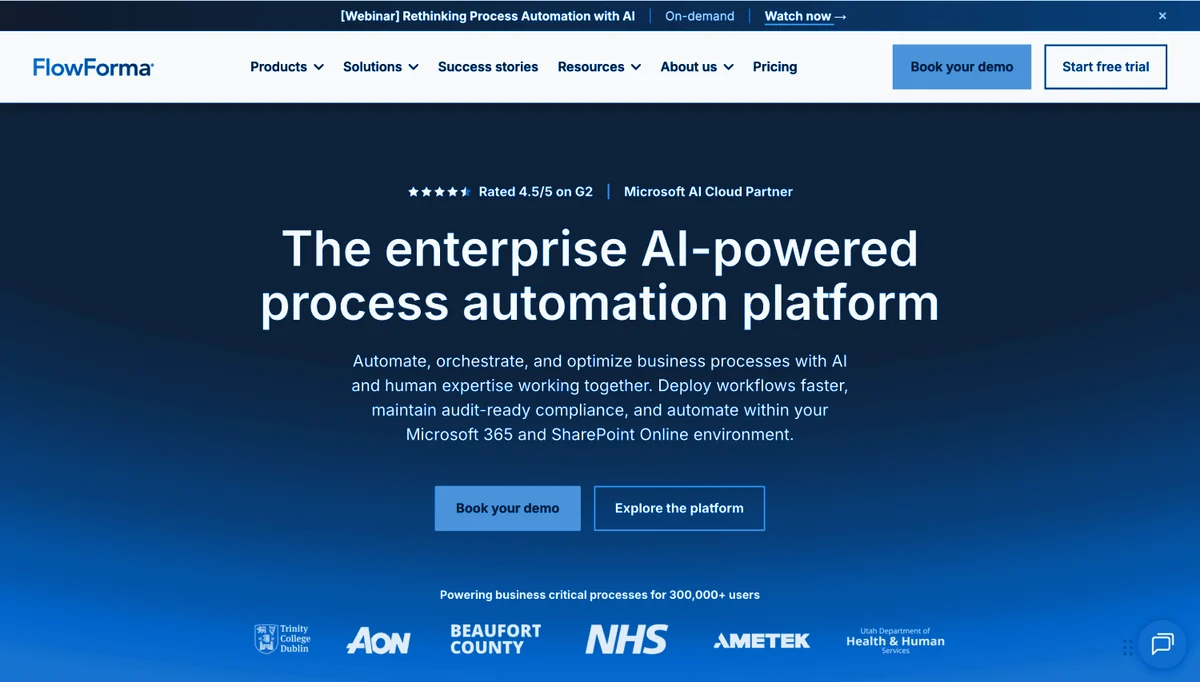
Best for: Private hospital, care, and multi-site groups whose supplier, equipment, service, and staffing contracts start as purchase requests or tenders.
Most supplier contracts begin as purchases, often through quotes or a tender, long before legal sees a draft. FlowForma Contract is an AI-powered product that brings people, AI agents and automation together to run contracts, procurement and tender management processes. FlowForma says it fits the way you already work and then helps you improve it, with AI agents working inside your rules at every step and every decision on record. Purchases, contracts, and tenders run in one system.
Purchase requests are sorted by type, value, and risk, with policy and budget checks. Agents draft from approved templates and clauses, check routine contracts against your legal playbook, and run multi-level approvals and e-signature in the same workflow. A contract register holds key terms, obligations, and milestones, and renewals are flagged early, with options to renew, renegotiate, or exit.
Your policy becomes the rules your team writes. Agents work inside them, people make the decisions, and every approval, rule decision, and agent action is on record. FlowForma says FlowForma Contract integrates with any system that has an API connector, most often ERP and finance systems, and FlowForma holds ISO/IEC 27001:2022 and Cyber Essentials certification.
Stored data sits in the EEA, with Ireland as the primary location, under a published data processing agreement. It is secure SaaS hosted on Microsoft Azure, with nothing for your team to host or maintain, and pricing is on request.
FlowForma Contract is built for procurement, contracts, and sourcing teams, not payer, credentialing, or physician compensation workflows, so teams whose risk sits there should start with symplr Contract or Ntracts.
2. symplr Contract: Best for Hospital Groups That Want a CLM Built Only for Healthcare
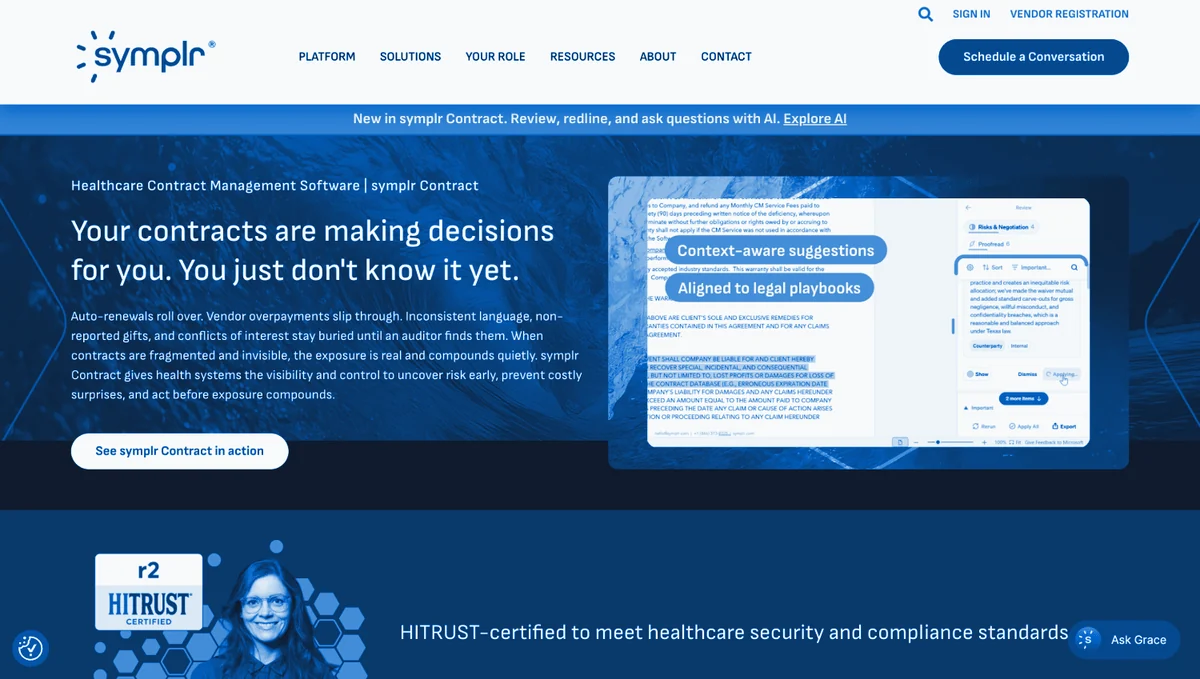
Best for: Hospital groups that run clinician agreements, supply chain requests, and vendor contracts under one compliance program.
symplr Contract is a CLM built only for healthcare and part of the symplr Operations Platform. It ships 12 pre-built healthcare workflows covering physician agreements, supply chain requests, and vendor management, plus pre-approved templates that include a BAA.
Its compliance tooling tracks conflicts of interest, gifts, and exclusion notices against HIPAA, Stark, and Anti-Kickback requirements, and it connects natively to Workday, Oracle, and Infor ERPs.
symplr Contract holds HITRUST r2 certification, renewed in July 2025, which helps when IT security review is the slowest step in your purchase. It also offers AI review and redlining, and pricing is on request.
symplr’s own pages speak to hospitals and health systems rather than independent practices, so a single clinic should confirm which of the 12 workflows it would use before it compares quotes.
3. Ntracts: Best for Physician Groups and Compliance-Led Health Systems
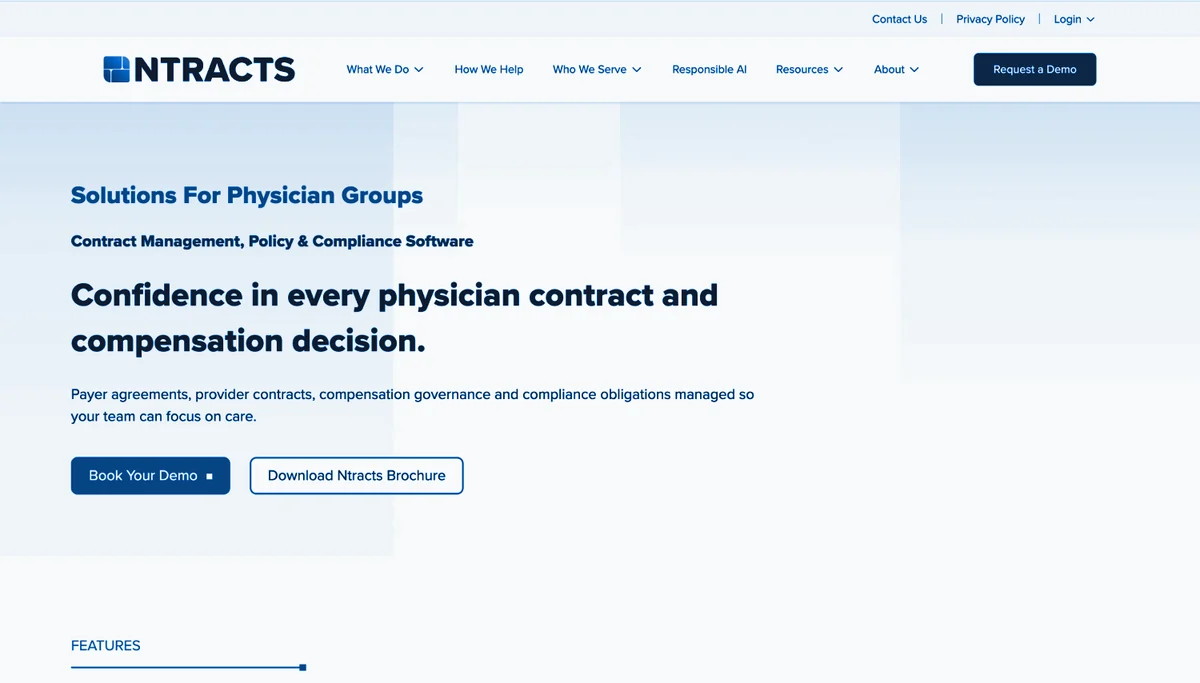
Best for: Physician groups and health systems that want contracts, compliance, policy, and physician governance in one system.
Ntracts is built exclusively for healthcare organizations, from hospitals and health systems to physician groups, and it shows in the clinician side of the product. Beyond the register and approval workflows, it covers compensation management, physician time-and-effort tracking, conflict-of-interest and exclusion monitoring, and credentialing verification services.
Ntracts says its intake workflows build in the right regulatory checks, from Stark Law for physician agreements to HIPAA applicability for BAAs. Pricing is a custom enterprise subscription with all users included, and smaller organizations can start on CLM Flex, a pre-configured edition.
Ntracts says it integrates with major EHR platforms, including Epic, and ERP systems, while credentialing, payroll, and compensation platforms connect through its partner ecosystem, so check those partners against your stack.
4. Agiloft: Best for Configurable Approval Routes Across Facilities
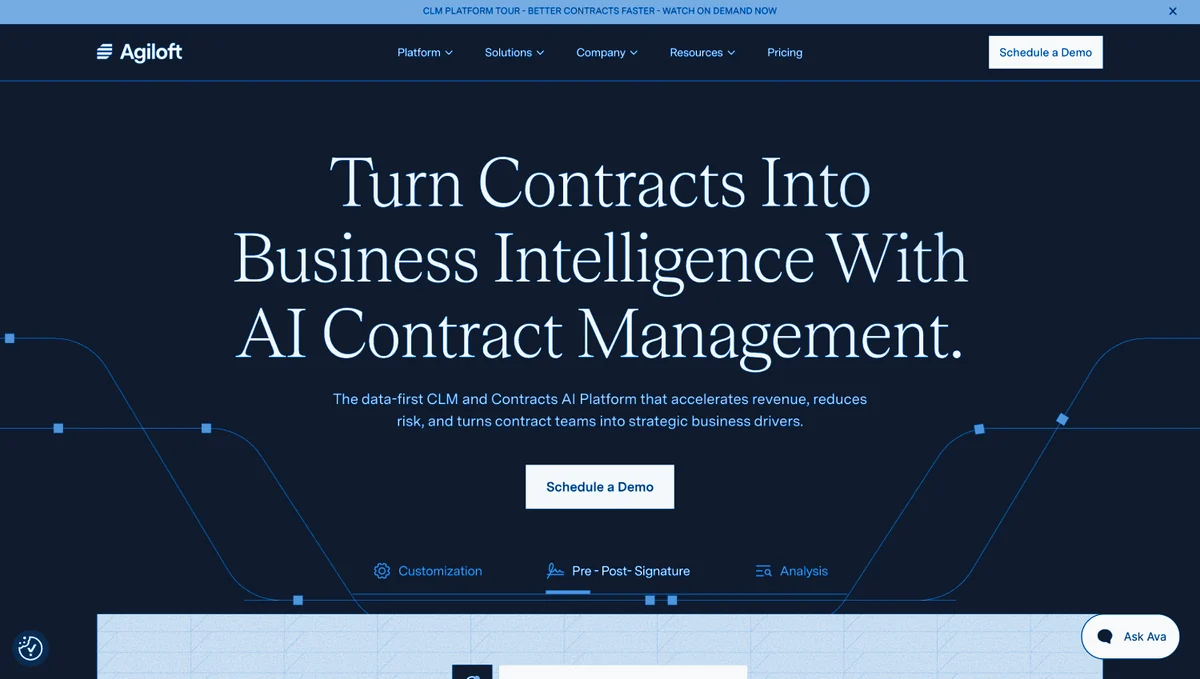
Best for: Groups that need different approval paths per contract type and facility, configured without code.
Agiloft's selling point is configuration. Approved team members can change contract types, approval chains, and processes without code, which suits a group where a BAA, a payer agreement, and a facilities lease each follow different routes.
Its healthcare page covers physician, payer, and vendor agreements, Astra adds AI review, and more than 1,000 pre-built connectors handle ERP and CRM links. E-signature comes through Docusign and Adobe Sign.
Agiloft's security page lists SOC 1, SOC 2, ISO 27001, and ISO 27701 certification, so ask Agiloft directly about BAA terms for PHI. Pricing is quote-based.
Because approved team members configure those routes themselves, the group needs someone who owns the configuration as contract types and approvers change.
5. Icertis: Best for Large Networks With Heavy Payer and Physician Contracting
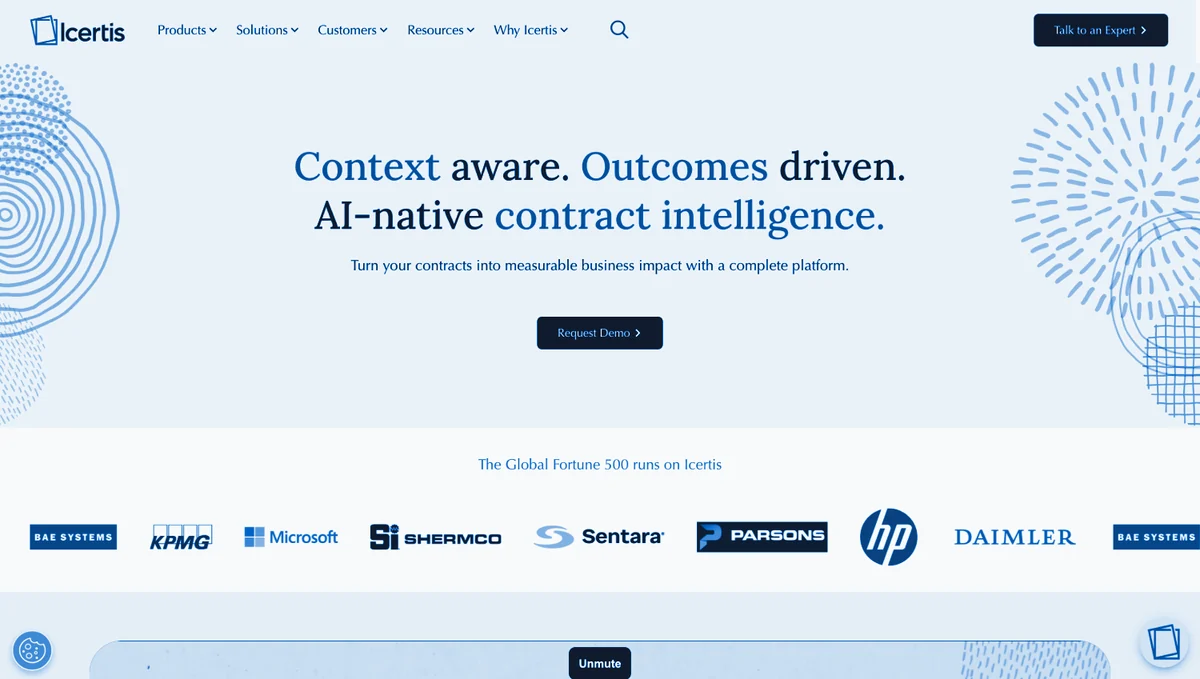
Best for: Large networks with heavy payer and clinician contracting and an enterprise IT team.
Icertis is enterprise contract intelligence software, and its Healthcare Providers edition is one of the more healthcare-specific offerings among the general-purpose vendors here.
It ships pre-configured physician, supplier, and payer contract types, automated fair market value controls, Stark and Anti-Kickback guardrails, and payer analytics that model reimbursement and identify underpayments. Icertis says its healthcare edition automates compliance with CMS and HIPAA requirements and connects to enterprise systems, and pricing is on request.
Icertis lists Accenture, Deloitte, KPMG, and PwC among its systems integration partners, so ask whether your deployment would need one and how that changes the timeline.
6. Ironclad: Best for Legal-Led, High-Volume Contracting
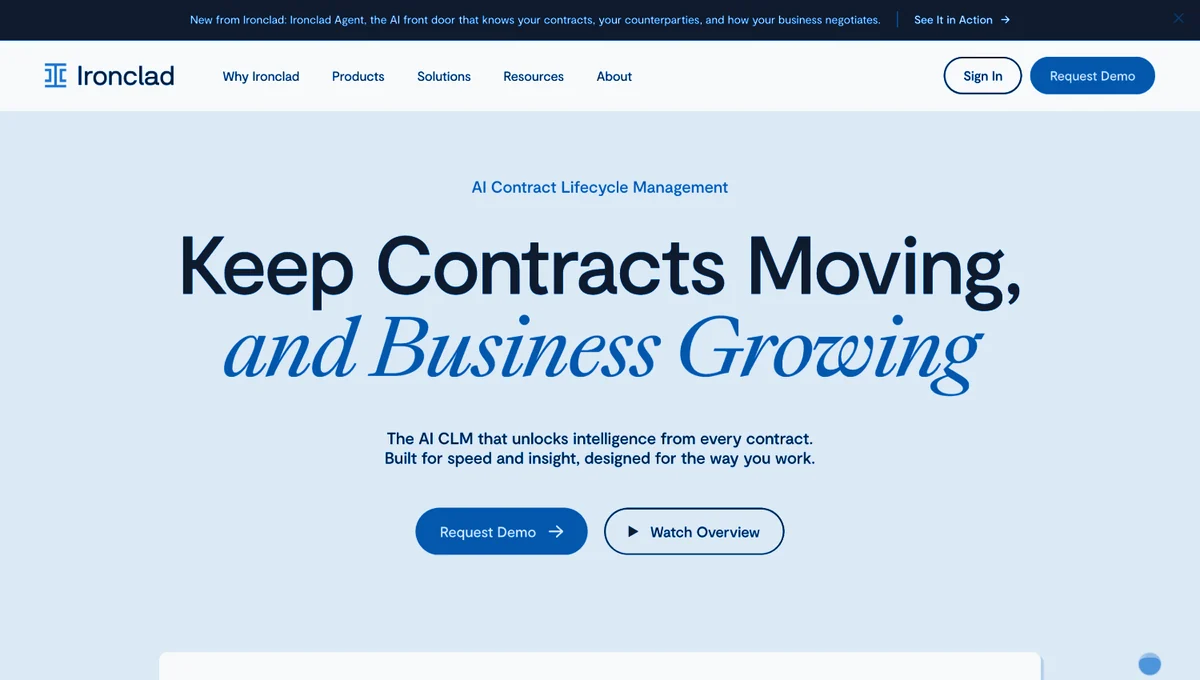
Best for: Legal-led groups that process a high volume of agreements and want legal to design the workflows.
Ironclad's no-code Workflow Designer lets legal operations build conditional approval paths, and its integrations reach Salesforce, Coupa, SAP, Docusign, Microsoft Word, and Teams.
Ironclad's security portal lists HIPAA among its compliance documents, available on request, alongside SOC 1, SOC 2, and several ISO certifications. Pricing is a custom quote shaped by the products, users, and workflows you buy, and some integrations are add-ons.
Ironclad doesn't list a healthcare edition, so your team configures clinician and payer workflows rather than switching them on.
7. Docusign CLM: Best for Organizations Already on Docusign eSignature
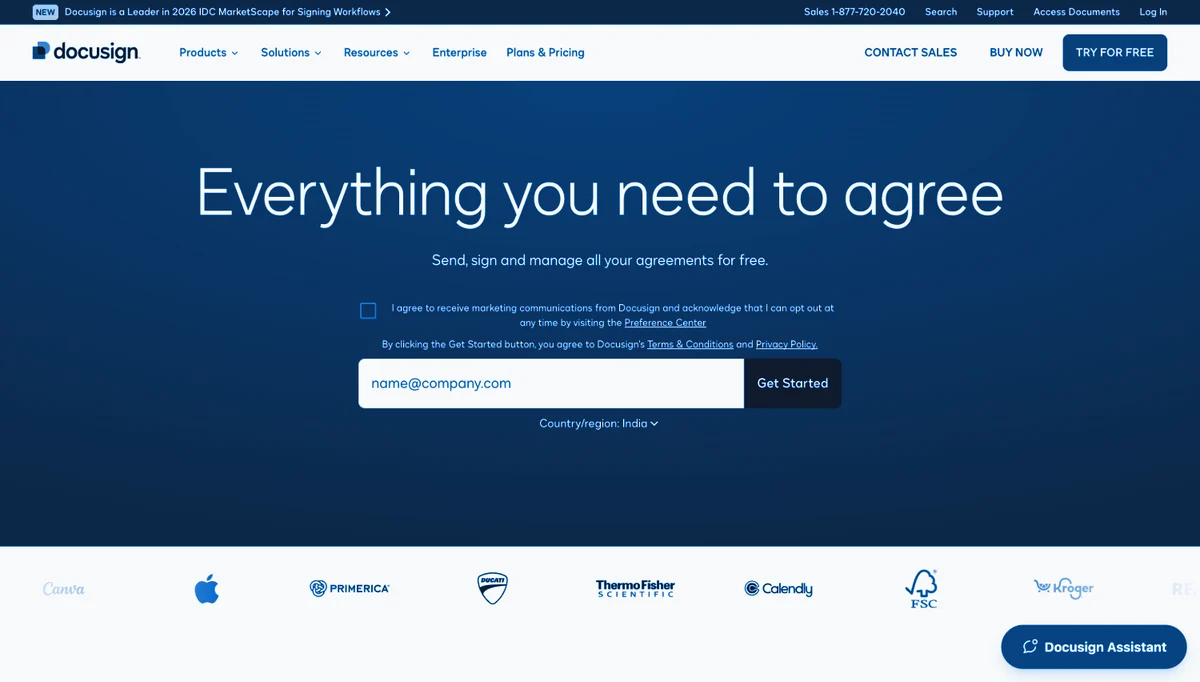
Best for: Organizations already standardized on Docusign eSignature.
Docusign CLM sits inside Docusign's Intelligent Agreement Management platform, with a drag-and-drop workflow editor, more than 100 pre-configured workflow steps, and the Iris AI engine for extraction and review.
It connects to Salesforce, SAP Ariba, and Coupa, which helps procurement teams already working in a source-to-pay suite. On healthcare, Docusign states plainly that it may sign a BAA with a covered entity, and it holds SOC 2 Type 2, ISO 27001, and FedRAMP authorization. CLM pricing goes through sales.
EHR connections run through Docusign's APIs and EHR interoperability partners, so budget for that work if contract data must reach clinical systems.
8. Conga CLM: Best for Groups That Run Contracting in Salesforce
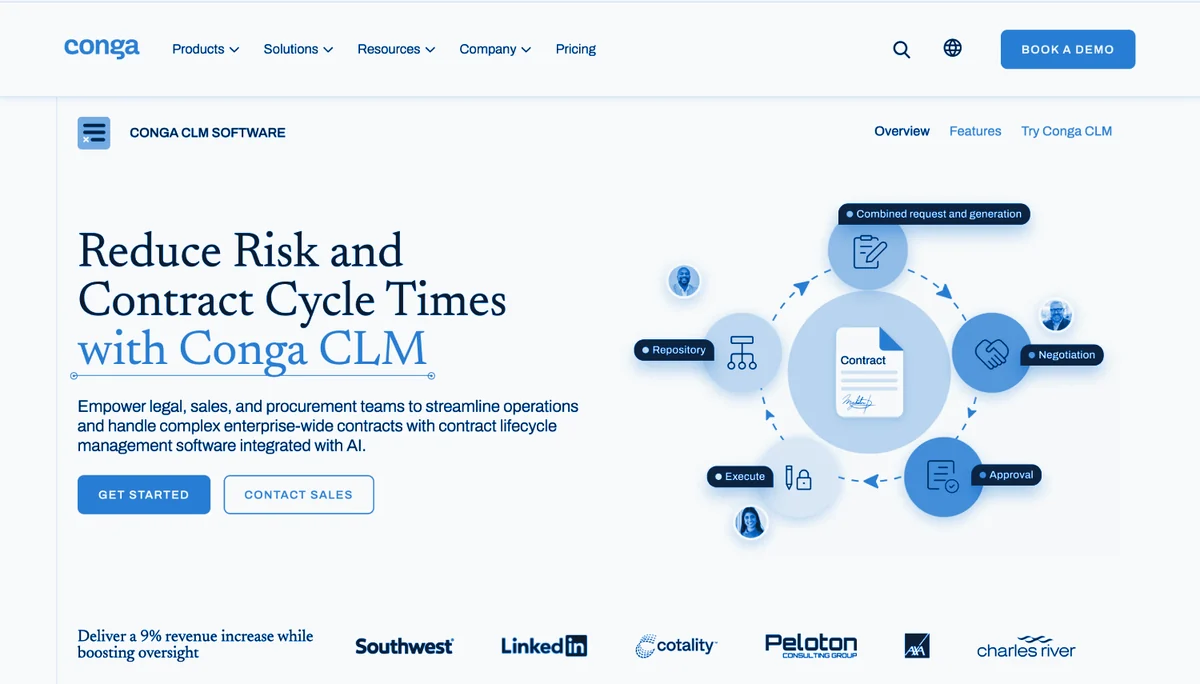
Best for: Groups that run commercial operations inside Salesforce or Microsoft Dynamics.
Conga CLM is part of a wider revenue platform that includes CPQ, document generation, and e-signature, and teams can manage contracts from inside Salesforce, Dynamics, and Office. Its offering for providers covers payer and MCO contracting, physician agreements with per-procedure and per-diem rates, and supplier contracting.
Conga’s trust center says annual audits verify adherence to the HIPAA Security Rule, alongside SOC 2 Type II and ISO 27001 and 27701 certification. Pricing is custom and quoted on request.
Conga sells CLM as part of its revenue platform, beside CPQ and document automation, so ask the demo to show the payer and supplier workflows from its healthcare page.
9. ContractSafe: Best for Independent Practices That Need a Simple Repository
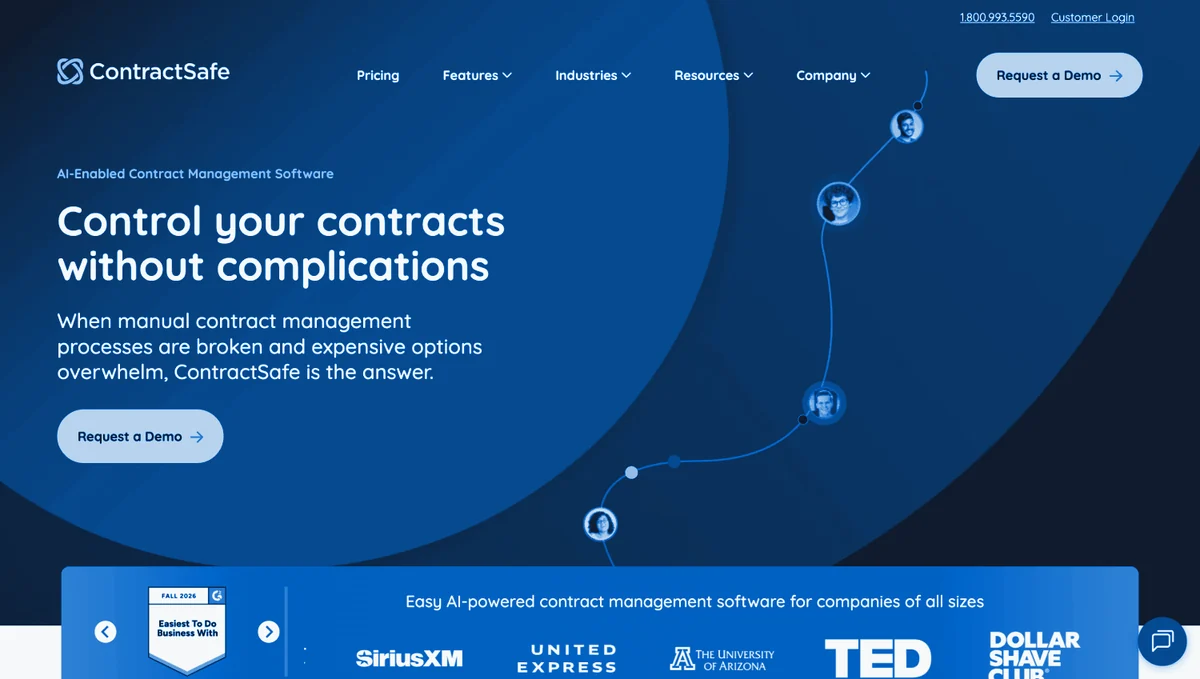
Best for: Independent practices and clinic groups that need a searchable repository and renewal alerts without an implementation project.
ContractSafe keeps things simple on purpose. You upload contracts, OCR and AI pull out key dates and terms, and alerts fire before renewals and deadlines. The middle tier adds approvals, Word integration, and e-signature, and the top tier adds full lifecycle management.
ContractSafe says it is SOC 2 and HIPAA compliant and lists ISO 27001 certification, supports single sign-on through Okta, and connects to Docusign and Salesforce. It publishes pricing based on contract volume and features, with all users included.
Approvals and e-signature start on the middle tier, so check which tier covers your routing before you compare quotes.
10. ContractWorks: Best for Small Clinics That Want Fast Setup
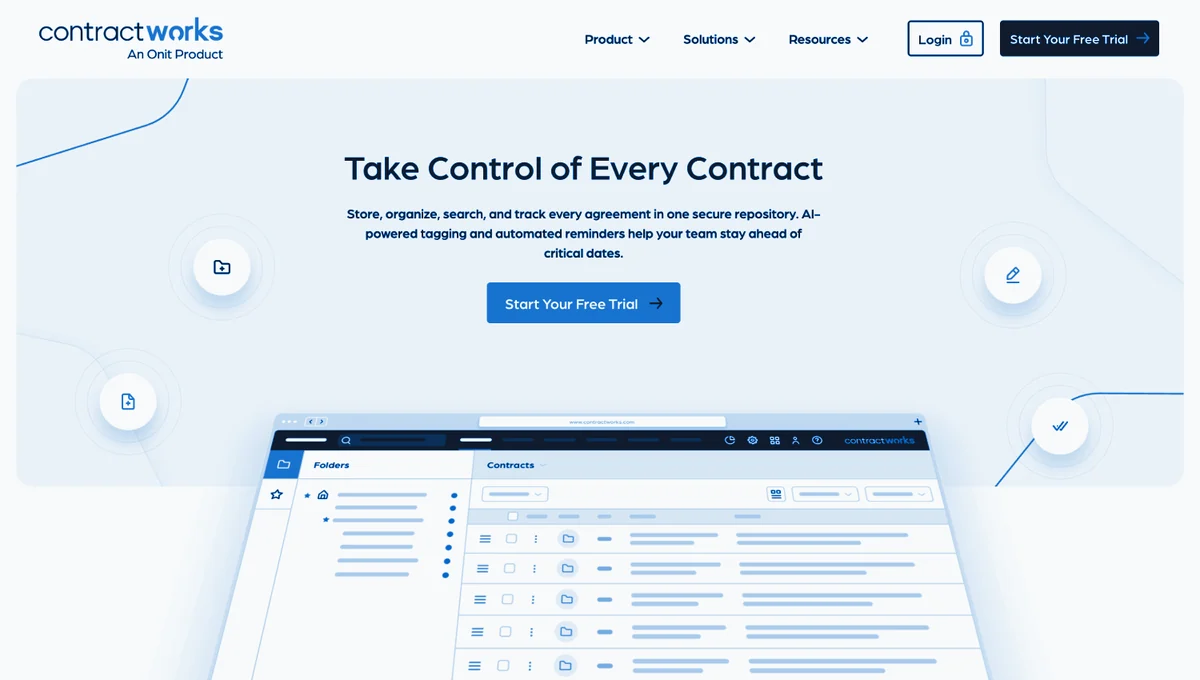
Best for: Small contract teams that want to start with a repository and add workflows later.
ContractWorks, an Onit product, starts as a secure repository with AI tagging of agreement types, parties, effective dates, and notice windows, plus alerts and built-in e-signature. Its healthcare page names payer, provider, and lease agreements, stored on AWS infrastructure with permission-based roles and activity logs.
ContractWorks is SOC 2 Type II compliant and includes all users on every plan. The Repository plan and ContractWorks Premium, which adds drafting, redlining, and approval workflows, both list starting prices, and Premium is bought through sales.
Onit’s trust center lists HIPAA for ContractWorks (not for ContractWorks Premium), but its public pages make no BAA statement, so confirm terms before storing contracts that contain PHI.
Also considered: PandaDoc, Contract Logix, Concord, and CobbleStone also appear on healthcare contract management shortlists. They were left out of the top 10 because this article focuses on platforms with healthcare-specific, purchasing-led, or full lifecycle strengths.
How does contract management software support HIPAA, BAA, Stark Law, and Anti-Kickback compliance?
Contract management software supports compliance work, and your legal and compliance staff still make the call. It can store BAAs, flag missing ones, attach fair market value evidence to compensation arrangements, and log approvals. Whether a vendor itself needs a BAA depends on whether it stores or processes PHI for you.
HHS’s Guidance on HIPAA and Cloud Computing 2016 sets the test. A cloud provider that creates, receives, maintains, or transmits ePHI for a covered entity is a business associate, even if it holds only encrypted data without the key. Using one to maintain ePHI without a BAA violates the HIPAA Rules. A contract system holding payer agreements with patient-level data is in that position; one holding only equipment leases may not be.
The same HHS guidance says OCR does not endorse, certify, or recommend specific technology, and Docusign's healthcare page states that no company's product can itself be HIPAA compliant.
Contract management vendors describe their positions in different terms, from HITRUST certification to annual Security Rule audits to no public statement, so treat each one as the start of a conversation.
Four BAA questions to ask every vendor
They follow from HHS's sample business associate agreement provisions (January 25, 2013), which spell out that subcontractors must accept the same restrictions and PHI must be returned or destroyed at termination, where feasible.
- 1Will the platform store or process PHI in our deployment, including in attachments and AI features?
- 2Will you sign a BAA, and on which plan or deployment?
- 3Which subcontractors, including hosting and AI model providers, touch our data, and are they bound by the same terms?
- 4Which safeguards cover our data, from encryption and access controls to audit logs and return or destruction at contract end, and what evidence will you share?
What software can and cannot do for Stark Law and Anti-Kickback reviews
The HHS Office of Inspector General’s Roadmap for New Physicians (checked November 2026) notes that remuneration under the Anti-Kickback Statute can include excessive compensation for medical directorships. It also calls the Stark law a strict liability statute, and the law reaches compensation arrangements.
Software helps by keeping the FMV assessment next to the agreement, holding signature until compliance signs off, and collecting time-and-effort logs. The Roadmap also makes providers responsible for not contracting with excluded individuals or entities, so exclusion monitoring matters for supplier contracts too.
Whether an arrangement fits a Stark exception or an Anti-Kickback safe harbor remains a legal judgment for counsel.
How does contract management software support UK GDPR, CMA Order, and Bribery Act compliance?
For UK and Irish private providers, contract management software supports the same compliance work under different laws: processor agreements under UK GDPR, consultant arrangements under the CMA Order 2014, and approval records that support a Bribery Act defense. Your legal and data protection staff still make the call.
| US element | UK equivalent |
|---|---|
| HIPAA / PHI | UK GDPR and the Data Protection Act 2018. Health data is “special category data” under Article 9. |
| BAA | Article 28 UK GDPR controller–processor agreement (often called a DPA) |
| Stark / Anti-Kickback | Bribery Act 2010, plus the CMA Private Healthcare Market Investigation Order 2014 (consultant incentives) |
| Payer contracts | Private medical insurer agreements: Bupa, AXA Health, Aviva, Vitality |
| Physician agreements / medical directorships | Consultant practising privileges and consultant fee arrangements |
| HITRUST / SOC 2 | ISO 27001, Cyber Essentials (Plus), NHS DSPT |
| CMS / HHS OCR | CQC (England); Healthcare Improvement Scotland and the Care Inspectorate (Scotland); HIW and Care Inspectorate Wales (Wales); RQIA (NI); the Information Commission (formerly the ICO) for data |
| RFP | Tender |
Each US element in this guide, with its nearest UK equivalent.
UK GDPR, Article 28, and where your data lives
Patient data is special category data under Article 9 of UK GDPR, and a contract platform that stores it acts as your processor and needs Article 28 terms: a written agreement covering instructions, subprocessors, security, breach notice, and deletion at contract end. Irish providers work under the EU GDPR, which sets the same requirements.
UK law treats EEA countries as adequate, so hosting in Ireland needs no extra transfer mechanism; U.S. hosting usually relies on the UK Extension to the EU-U.S. Data Privacy Framework (if the vendor is certified to it), the UK Addendum, or an IDTA. Check AI features too, since some vendors process AI requests outside the region that stores your data.
Put the four BAA questions in Article 28 terms: will the platform store patient data, including in AI features; will the vendor sign Article 28 terms; which subprocessors touch your data, and where; and how is data deleted at contract end?
Consultant and supplier arrangements: the CMA Order 2014 and the Bribery Act 2010
The CMA’s Private Healthcare Market Investigation Order 2014 bars private hospital operators from offering referring consultants incentives to refer or treat patients at their facilities. Operators must also publish, on each hospital’s website, which consultants hold shares or other financial interests there and what they pay consultants who hold part-time posts. It is the nearest UK equivalent to Stark, and software helps by keeping each arrangement, its market-value evidence, its approval, and its publication status in one record.
The Bribery Act 2010 makes a company liable for failing to prevent bribery unless it had adequate procedures, and approval trails and gift and hospitality logs are the evidence those procedures leave.
Supplier contracts carry two more UK duties. Organizations with turnover of £36 million or more publish an annual Modern Slavery Act statement, which supplier records support. Medium and large clients engaging contractors through the contractors’ own companies also need an off-payroll (IR35) status determination on file.
What changes if you deliver NHS-funded services?
Private providers delivering NHS-funded hospital, diagnostic or community care in England hold that work on the NHS Standard Contract, with stricter reporting than their private business. Contract management software helps after award: it tracks the contract’s obligations, reporting dates, and renewal points, and runs the subcontractor and supplier contracts behind it through your usual approvals.
NHS bodies now award healthcare services under the Provider Selection Regime (since January 1, 2024), and goods and non-healthcare services under the Procurement Act 2023 (since February 24, 2025).
Any provider with access to NHS patient data also completes the Data Security and Protection Toolkit; independent providers designated as Operators of Essential Services moved to its CAF-aligned version for 2025-26.
How much does healthcare contract management software cost in 2026?
Most healthcare contract management platforms are priced on request, so budgets start with a quote. Price usually moves with users, contract volume, modules such as procurement or e-signature, integrations, and implementation services. ContractSafe and ContractWorks publish starting prices for their plans; FlowForma Contract, symplr Contract, and the enterprise CLM platforms in this list quote individually.
Each pricing model, checked in November 2026, carries its own cost risk. Volume-based pricing grows with your contract count, user-shaped quotes grow with headcount, and modular quotes grow with every add-on you accept during the sales cycle.
So the useful budget questions are about scope:
- How many contracts does the quote cover, and what happens past that number?
- Are implementation, data migration, and training included?
- Which integrations cost extra, and are AI features part of the plan?
- Does the quote include enough e-signature licenses, or are extra licenses billed separately?
A multi-site group should have every vendor price the same scope so quotes compare line by line.
How should you test contract management software before you sign?
Give every shortlisted vendor the same five demo scenarios, built from your own contracts, and score each demo with the same weights. Then pilot the winner for 30 days on about 25 representative contracts, so you see how the platform handles your real backlog rather than sample data.
Five demo scenarios to run with every vendor
- 1Supplier contract: from purchase request to signature, with a budget check and a second approver above a value threshold.
- 2Medical director agreement: the fair market value assessment attached and a compliance sign-off required before signature.
- 3BAA search: every BAA with one named vendor, showing execution dates and amendments.
- 4Renewal: a 90-day notice period, showing who is alerted, when, and what happens if nobody responds.
- 5Audit export: the full trail for a single contract, listing every approver, change, and signature.
A suggested scoring model
These weights are suggested, not a standard; shift them toward the contracts that carry your risk.
- Fit with your contract mix and approval routes30%
- Compliance controls, including BAA terms and the audit trail25%
- Renewal and obligation tracking20%
- Integration with your ERP and e-signature tools15%
- Ease of use for approvers outside legal10%
How to run a 30-day pilot
Spread the pilot contracts across clinician, payer, supplier, and BAA categories, then measure four things:
- How accurately the platform extracts dates and parties.
- How long approvals take.
- Whether it flags each renewal before its notice deadline.
- Whether the audit record is complete.
A free trial lets you run the pilot on the product you’d buy: ContractWorks offers 14 days, ContractSafe offers a free trial, and FlowForma Contract offers 30 days.
Which contract management software fits your type of private healthcare provider?
Match the platform to the contracts that carry your risk. Independent practices need a simple register with renewal alerts. Physician groups need compensation and FMV tracking. Private hospital and care groups often need healthcare agreement workflows plus purchase-to-contract control for supplier, equipment, and staffing contracts. Large networks need enterprise legal review.
| Provider type | Typical contract mix | Start with | Why |
|---|---|---|---|
| Independent practice or single clinic | Leases, supplier agreements, BAAs, a few medical director contracts | ContractSafe or ContractWorks | A searchable register and alerts without an implementation project |
| Physician group or specialist clinic network | Compensation arrangements, medical directorships, payer agreements | Ntracts | Compensation, time-and-effort, and exclusion tracking in one system |
| Private hospital group | Clinical, payer, supplier, and equipment contracts across sites | symplr Contract, or Icertis at larger scale | Healthcare workflows, compliance tracking, and ERP links |
| Care home or assisted living group | Supplier, agency staffing, facilities, and equipment contracts | FlowForma Contract | Purchase-to-contract approvals or configurable routing across sites |
| Group with a legal operations team | High-volume, legal-led contracting | Ironclad, Icertis, or Agiloft | High-volume legal review; Docusign CLM or Conga CLM if you’re standardized on Docusign or Salesforce |
| UK independent hospital group | Consultant practising privileges, insurer agreements (Bupa, AXA Health, Aviva, Vitality), equipment, suppliers | FlowForma Contract for supplier and equipment contracts; Agiloft for consultant and insurer agreements | Purchase-to-contract control, plus configurable routes for UK agreements |
| UK care home group | Local authority placements, agency staffing frameworks, suppliers | FlowForma Contract | Purchase-to-contract approvals with staffing and supplier records in one register |
| UK private clinic, diagnostics, or dental chain | Insurer agreements, MHRA-regulated equipment leases, NHS subcontracts | ContractSafe, or FlowForma Contract as purchasing grows | EU hosting for a simple register; approvals and tenders as sites grow |
If your riskiest contracts are physician, payer, and BAA agreements, choose symplr Contract or Ntracts, because their workflows are built for them. If most contracts start as a purchase or tender, choose FlowForma Contract, because approvals, sourcing, and renewals stay with the contract.
If you run a large network with a legal operations team, choose Ironclad, Icertis, or Agiloft, because they handle high-volume legal reviews. If you’re a UK or Irish provider, shortlist vendors that sign Article 28 terms and state where your data is stored, because symplr Contract and Ntracts are built around U.S. rules.
Healthcare-specific vs general-purpose CLM
Two systems can be the right answer. A hospital group might run clinician and payer agreements in a healthcare-specific platform and supplier contracts in a purchasing-led one, because the people and evidence behind them barely overlap.
Judge any contract management software for private healthcare providers by how it runs these five scenarios on your own documents. If supplier and purchase-led contracts are where your renewals slip, book your demo of FlowForma Contract on your own process.
Frequently Asked Questions
How does contract management software prevent missed renewals in healthcare?
Contract management software reads the notice period from each signed contract and alerts the owner ahead of that deadline, which often falls months before expiry. On a three-year equipment contract with 90 days’ notice, alerts at 180, 120, and 100 days before expiry (90, 30, and 10 days before the notice deadline) give procurement time to renegotiate. Set alerts from the notice date, not the expiry date.
Can contract management software track physician agreements and fair market value reviews?
Healthcare-focused platforms can store compensation terms, the FMV assessment, the reviewer, and the next review date as structured fields on each agreement. That record shows compliance which arrangements are due for review before compensation changes or a contract renews. The software keeps the evidence in order, while the review itself stays with qualified people.
Can contract management software manage payer contracts and reimbursement?
Most contract management software tracks payer terms, amendments, and renegotiation dates, but few products model reimbursement; Icertis’s Healthcare Providers edition is one that does. If underpayment detection is your main goal, evaluate that capability directly or use a dedicated payer-contract tool. The contract system then remains the register of record for terms and dates.
Can one platform manage contracts across several clinics or facilities?
One platform can manage contracts across several facilities when it offers facility-level ownership and permissions with one consolidated register. In a five-site group, each site manager sees and approves that site's contracts, while the finance director sees every renewal across all five in one report. Ask each vendor to show facility-level permissions in the demo before you shortlist it.
Is it safe to use AI contract review on healthcare contracts?
AI contract review is easier to justify on healthcare contracts when the vendor confirms how long it keeps your data, that your data doesn't train its models, and which subprocessors see it. Get those answers in writing, ideally in the BAA. A person should still check every clause the AI extracts before anyone relies on it.
Which contract management software will sign a BAA?
Vendors state this in different ways, so ask each one in writing. Docusign says it acts as a business associate when providers use Docusign eSignature for documents with PHI, symplr Contract holds HITRUST r2 certification and ships a BAA template for your own vendor agreements, though its pages don't say whether symplr signs one, and ContractSafe says it is HIPAA compliant. For any platform whose pages don't state a position, ask the four BAA questions above before PHI goes in.
What is the best contract management software for a small private practice?
ContractSafe and ContractWorks suit small practices that need a searchable repository and renewal alerts without an implementation project, and Ntracts offers CLM Flex, a pre-configured edition for smaller healthcare organizations. Choose by how many contracts you hold and whether any contain PHI.
What is the best contract management software for supplier and vendor contracts in a private hospital group?
FlowForma Contract fits supplier, equipment, service, and staffing contracts that start as purchase requests or tenders, because purchases, contracts, and tenders run in one system, with approvals, the contract register, and renewal alerts in the same workflow. Groups whose main risk is physician or payer contracting often run those agreements in symplr Contract or Ntracts alongside it.
Is there HIPAA compliant contract management software?
HHS's Office for Civil Rights does not certify or endorse specific technology, so “HIPAA compliant” on a vendor page is the vendor's own claim. What matters is whether the vendor will store or process PHI for you and will sign a BAA that covers subcontractors and the return or destruction of PHI at the end of the contract.
Which contract management software suits UK private healthcare providers?
Start with vendors that publish a UK GDPR data processing agreement and say where data is stored. FlowForma Contract stores data in the EEA, with Ireland primary, under a DPA with the UK Addendum, though AI requests may be processed outside the EEA. ContractSafe offers hosting in Ireland, and Docusign and Agiloft publish DPAs covering UK transfers.